|
THE DOUGLAS DC-7C
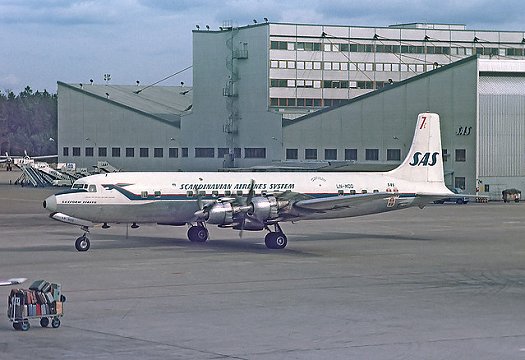 This "race" began in the early 1950's between Douglas Aircraft Company located in Long Beach, California, and the Lockheed Aircraft Corporation of Burbank, California. Airlines of the day were looking for an airliner that could fly west-to-east across the United States in eight hours or less. This "race" began in the early 1950's between Douglas Aircraft Company located in Long Beach, California, and the Lockheed Aircraft Corporation of Burbank, California. Airlines of the day were looking for an airliner that could fly west-to-east across the United States in eight hours or less.
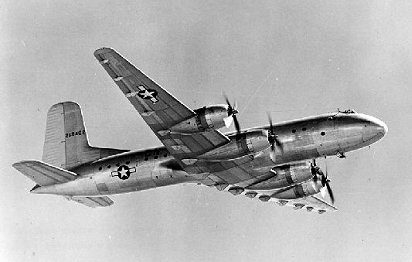 The original version of the "DC-7" as proposed by Pan American World Airways, as early as 1945, was to be a civil version of the Douglas C-74 Globemaster used by the military. The civil version of this airplane was never produced. The original version of the "DC-7" as proposed by Pan American World Airways, as early as 1945, was to be a civil version of the Douglas C-74 Globemaster used by the military. The civil version of this airplane was never produced.
The prototype of a revived DC-7, based on the DC-4/6 series airframes, flew on May 18, 1953. American Airlines had requested an airplane that could fly coast-to-coast in eight about hours. Douglas was reluctant to build the DC-7 until American's president C.R Smith ordered 25 at an astounding price of $40 million, which covered Douglas' development costs. The airplane entered service with American in November 1953.
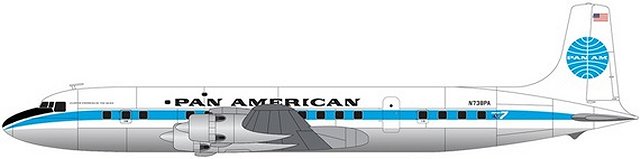
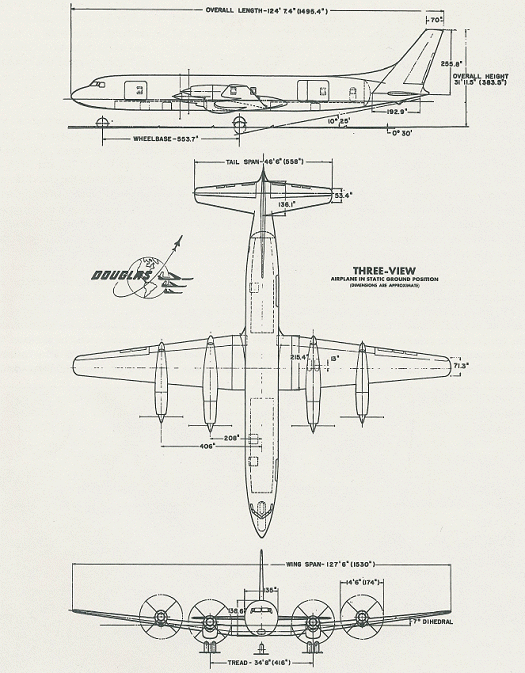
In 1956 Douglas produced the DC-7C, called the Seven Seas, a variant of the DC-6B. The DC-7C, a long range varient of the DC-7B used the same fuselage as the DC-6B but with a 40 inch plug installed in front of the wing and a 40 inch plug aft of the wing which allowed the airplane to carry 26 more passengers. The wingspan was extended five feet on each side at the wing root which allowed for increase fuel capacity and longer range. This also moved the engines five feet further from the fuselage which made it quieter with less vibration. Douglas built 125 of the DC-7C's.
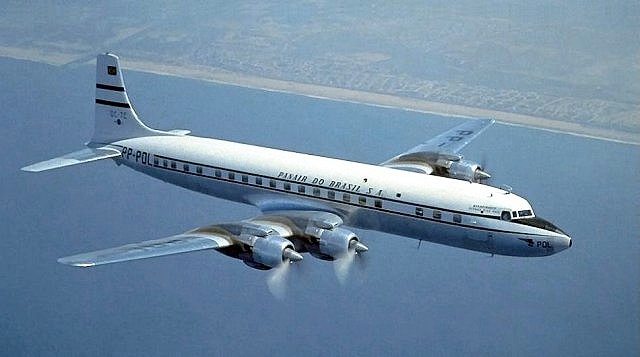
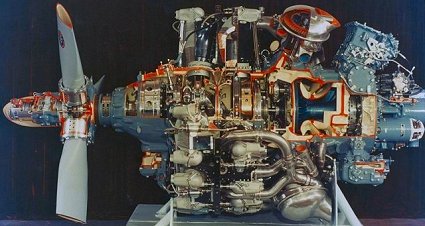 The DC-7 series of airplanes used the Wright R-3350, 18 cylinder, Double-Row, Turbo-Compound engines which produced 3400 HP. This engine was simply two smaller 9 cylinder radials "bolted" together in-line. This was the same engine used on the Boeing B-29. These engines utilized three power recovery turbines, which turned the otherwise wasted exhaust gases into rotary motion and transferred this motion (power) to the crankshaft. These devices produced an additional 600HP and increased the efficiency of the engine. The engines pushed the state of the art in piston engines to their limit. They were very complex and thus very unreliable in service. Of course, in the day of these large piston engines it wasn't, "Will we have an engine failure?", it was, "Which one is going to fail this time?" The DC-7 series of airplanes used the Wright R-3350, 18 cylinder, Double-Row, Turbo-Compound engines which produced 3400 HP. This engine was simply two smaller 9 cylinder radials "bolted" together in-line. This was the same engine used on the Boeing B-29. These engines utilized three power recovery turbines, which turned the otherwise wasted exhaust gases into rotary motion and transferred this motion (power) to the crankshaft. These devices produced an additional 600HP and increased the efficiency of the engine. The engines pushed the state of the art in piston engines to their limit. They were very complex and thus very unreliable in service. Of course, in the day of these large piston engines it wasn't, "Will we have an engine failure?", it was, "Which one is going to fail this time?"
|
Passenger Capacity:
Length:
Wingspan:
Maximum T.O. weight:
Powerplants:
Maximum Speed:
Cruise Speed:
Range:
Service Ceiling:
|
105
112ft 3in
127ft 6in
143,000lbs
(4) Wright R-3350-988TC18EA1-2, 3400hp
406mph (353kts)
359mph (308kts)
5600sm (4866nm)
28,400ft
|
|
|
Douglas proposed a turbo-prop version of the Seven Seas, designated the DC-7D, to attain more performance and allivate the unreliablity of the piston engines. However, this airplane was never built.
|
THE LOCKHEED L-1649 STARLINER
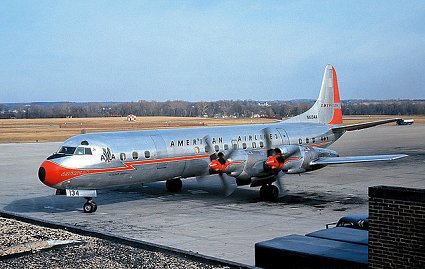
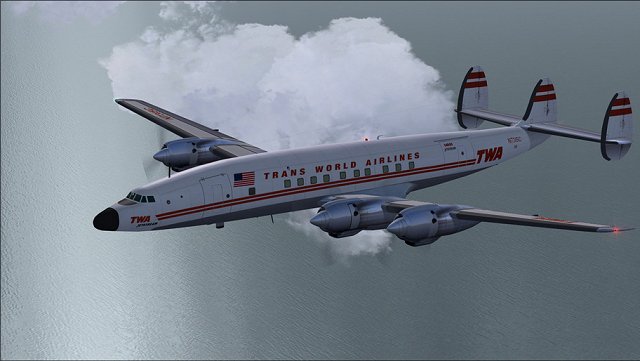
About the same time that Douglas starting operations with the DC-7C, Lockheed introduced the L-1649 Starliner with trans-atlantic service by TWA (TWA called the airplane the Jetstream) to London and Frankfurt.
 Earlier Lockheed proposed this airplane at the L-1549 fitted with Pratt & Whitney 5500 hp PT2G-3 turboprops. The 1549 had a new high aspect ratio wing to carry the extra fuel required by the turboprop engines. It would have been faster than the DC-7C but had comparable range. Four were built, two for the Air Force and two for the U.S. Navy. Allison later dropped the PT2 project due to unexpected unrealiability, high specficic fuel consumption, and thus high operation costs. Earlier Lockheed proposed this airplane at the L-1549 fitted with Pratt & Whitney 5500 hp PT2G-3 turboprops. The 1549 had a new high aspect ratio wing to carry the extra fuel required by the turboprop engines. It would have been faster than the DC-7C but had comparable range. Four were built, two for the Air Force and two for the U.S. Navy. Allison later dropped the PT2 project due to unexpected unrealiability, high specficic fuel consumption, and thus high operation costs.
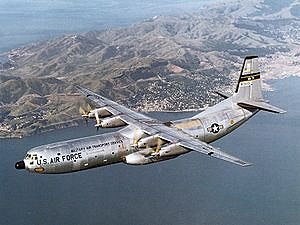 However, later the military and Pratt & Whitney revived the PT2 as the T34 and used it to power the Douglas C-133 (which was also plagued with marginal reliability). More Douglas C-133 info: CLICK here. However, later the military and Pratt & Whitney revived the PT2 as the T34 and used it to power the Douglas C-133 (which was also plagued with marginal reliability). More Douglas C-133 info: CLICK here.
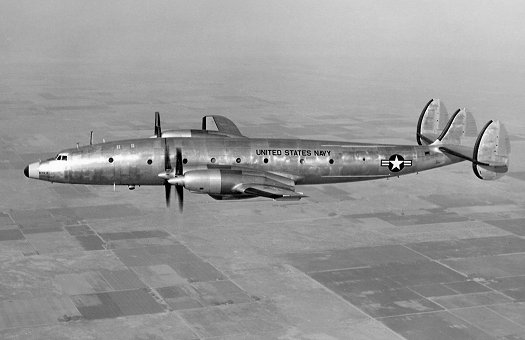
So, as it turned out the L-1649 was produced but with the same Wright 3350 Turbo-compound engines that powered the Douglas DC-7C but with the advantage of the 150 foot high aspect ratio wing which allowed it to carry more fuel and have more range than the DC-7C. The L-1649A would be capable of flying non-stop from California to Europe. On June 1, 1957 TWA (Trans World Airlines) flew the first in service flight from New York to London. In July 1958 TWA scheduled 60 flights a week from Europe to New York; 30 were L-1649's. Three 1649's a week flew the polar route from Europe to California (a first), sometimes non-stop. Air France flew the 1649 twice-weekly ORY-ANC-TYO in 30 hr 45min (scheduled). One of the longest airline flights in history was made in October 1957 by an L-1649 Starliner flying from San Francisco to London in 23 hours and 20 minutes.
|
 |

|
Passenger Capacity:
Length:
Wingspan:
Maximum T.O. weight:
Powerplants:
Maximum Speed:
Cruise Speed:
Range:
Service Ceiling:
|
99
116ft 2.4in
150ft 6in
156,104lbs
(4) Wright R-3350-988TC18-EA-2, 3400hp
377mph (324kts)
290mph (249kts)
6180sm (5370nm)
23,700ft
|
|
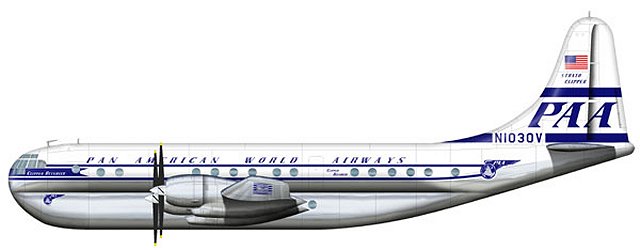
THE BOEING 377 STRATOLINER
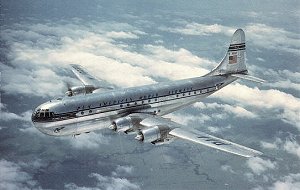 There was another piston-engine airliner of the time of which we should take note simply because it was the first of the last. The Boeing Model 377 called the Stratoliner. This airplane was introduced into service with Pan American Airways in April of 1949, well before the DC-7 models, or the L-1649 Constellation. This airplane was, for it's time, was truly a wonder, and ushered in the era of the modern airliner. Prior to 1949 there simply was nothing like it.
This airplane would have never existed if, in late 1945 William Allen, then President of the Boeing Company, had not spent company capital to finance it's development (he ordered 50 Stratoliners built) without a single airline order on the books. Only 55 production airplanes were built. On November 29, 1945 Pan American World Airways became the launch customer with the largest commercial aircraft order in history, a $24.5 million order for 20 Model 377 Stratoliners.
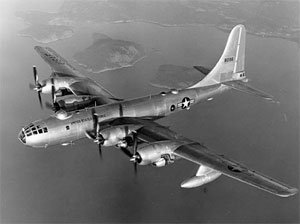
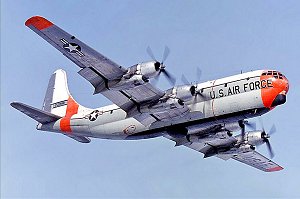
 The 377 was a civil version of the USAF C-97 Stratofreighter.
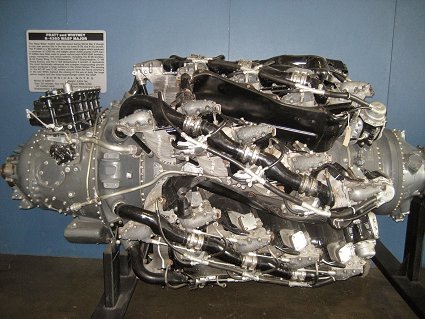
This airplane was powered by Pratt & Whitney R-4360, Wasp Major, 28 cylinder radials which was essentially four smaller 7 cylinder radials "bolted" together. This engine produced 3500 hp. Eack successive bank of cylinders was rotated out of line with the previous one to provide better cooling. This earned the engine the nickname of "The Corncob".
The 377 was a civil version of the USAF C-97 Stratofreighter.
This airplane was powered by Pratt & Whitney R-4360, Wasp Major, 28 cylinder radials which was essentially four smaller 7 cylinder radials "bolted" together. This engine produced 3500 hp. Eack successive bank of cylinders was rotated out of line with the previous one to provide better cooling. This earned the engine the nickname of "The Corncob".
The R-4560 was used widely on some rather famous airplanes; the B-50, the B-36, the Hughes Spruce Goose, the Boeing C-97 and KC-97 tankers, and many others of the day. It has been adapted to some famous Reno Air Race winners also, like F4G-2 Corsair.
|
Passenger Capacity:
Length:
Wingspan:
Maximum T.O. weight:
Powerplants:
Maximum Speed:
Cruise Speed:
Range:
Service Ceiling:
|
114
110ft 4in
141ft 3in
148,000lbs
(4) Pratt&Whitney R-4360-B6 Wasp Major, 3500hp
375mph (326kts)
301mph (249kts)
4200sm (3650nm)
32,000ft
|
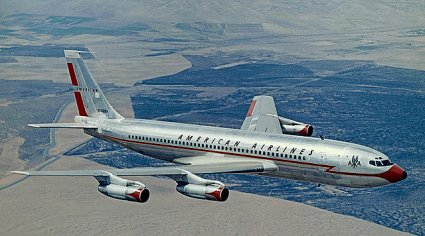
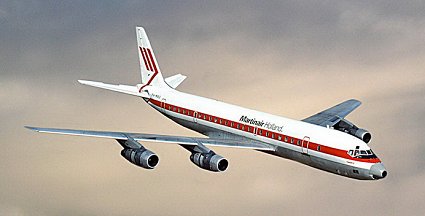
These three famous airliners were the last of the age of the piston engined airliners. The engines on these airplanes were designs that pushed the limits of piston engines to diminishing returns and beyond. These engines produced approximately one horsepower per pound of engine weight. The Wright R-3350 engine weighed 2670 pounds, for 3400 Hp; the Pratt & Whitney R-4360 weighed 3870 pounds, for 3500 hp! These airplanes flew the long-haul routes of the world for only 15 or so years until, in the distance, came the sound of the jet engines on the British De havilland Comet, the United States Boeing 707, and the Douglas DC-8.
Worldwide the airline industry pretty much bypassed the turbo-prop airliner, with a few notable exceptions. These airplanes carried about the same passenger load with less range but slightly higher speed.